
 Price
Price
 Motor (Nominal)
 Range
Range
 Battery
Technical Architecture
Overview

Price
$1,299
MSRP

Motor
750 W
Nominal Output

Battery
672 Wh
Battery Capacity

Speed
—
Unlocked Top Speed

Payload
350 lbs
Max Load Capacity · bike weighs 101 lbs

Safety Standards
UL 2849 Certified
Electrical System Integrity
UL 2271 Certified
Battery Performance & Safety

Foldable
No
Frame style(s): Step-Thru
Score breakdown
41.5 out of 100 — Not recommended
The arithmetic, in full
Power & Drive7 / 16
Battery & Range6.5 / 21
Safety & Braking7.5 / 14
Ride Quality & Components11.5 / 32
Utility & Practicality6 / 8
Display & Connectivity3 / 9
Performance score41.5 / 100
Value — 41.5 points ÷ $1,29931.9 pts per $1,000
Show every metric and rung — how each subtotal was earned
Every metric below is a ladder. The bike sits on one rung, and that rung’s points are the points it earns. Add the six category subtotals and you get the score at the top of the page. There is no weighting step, no normalisation and nothing rounded away.
Adding a bike never moves another bike’s score. The score is absolute, not a curve. A bike that earned 62 in January earns 62 in December unless its specification changes or we correct a data error — and we log every correction.
Power & Drive
Peak power output5.5 / 9.5
This bike: 1056 W — 1,050–1,199 W
Under 600 W0 pts600–749 W1.5 pts750–899 W2.5 pts900–1,049 W4 pts1,050–1,199 W5.5 ptsThis bike1,200–1,349 W7 pts1,350–1,499 W8 pts1,500 W or more9.5 pts
System voltage x controller amperage - the one number that decides acceleration and hill climbing. Scored once, not three times.
Pedal-assist sensing0 / 3.5
This bike: Cadence — Cadence sensor only
Cadence sensor only0 ptsThis bikeTorque sensor3.5 pts
A torque sensor measures how hard you pedal and matches it. Every bike has at least a cadence sensor, so cadence alone earns nothing.
Throttle1 / 1
This bike: Yes — Throttle included
No throttle0 ptsThrottle included1 ptThis bike
Lets you pull away from a stop without pedalling - useful with a load, on a hill, in traffic, or with joint pain.
Speed class0.5 / 2
This bike: 20 mph — 20–27 mph (Class 1/2)
Below 20 mph0 pts20–27 mph (Class 1/2)0.5 ptsThis bike28 mph (Class 3)2 pts
Class 3 bikes (28 mph) keep pace with city traffic. Class 1 and 2 stop assisting at 20 mph.
Battery & Range
Usable battery capacity6 / 12
This bike: 672 Wh — 650–799 Wh
Under 350 Wh0 pts350–499 Wh2 pts500–649 Wh4 pts650–799 Wh6 ptsThis bike800–999 Wh8 pts1,000–1,299 Wh10 pts1,300 Wh or more12 pts
Total watt-hours you can carry, counting a second battery if one is included. Capacity is scored once whether it arrives in one pack or two.
Charger speed0 / 3
This bike: 96 W charger — Under 100 W
Under 100 W0 ptsThis bike100–149 W0.5 pts150–199 W1 pt200–249 W2 pts250–349 W2.5 pts350 W or more3 pts
The charger's own output in watts. Scored on the charger alone so that a large battery is not penalised, and so a 36 V high-amp charger cannot pass for a 48 V one.
Cell supplier0 / 2
This bike: China Tier 1 — Not LG, Samsung or Panasonic
Not LG, Samsung or Panasonic0 ptsThis bikeLG, Samsung or Panasonic2 pts
Cells from LG, Samsung or Panasonic publish cycle-life and thermal data. Anything else earns nothing.
Battery ingress protection0.5 / 4
This bike: IPX5
Not published or IPX40 ptsIPX50.5 ptsThis bikeIP65 / IPX62 ptsIPX7 / IP674 pts
The published IP rating of the battery pack - not the bike. IPX5 is a water-jet test only; IP65 adds a dust-tight claim; IPX7 adds immersion.
Safety & Braking
Braking system3 / 6.5
This bike: Hydro 2p — Hydraulic disc, 2-piston
Rim, V-brake, coaster or mechanical disc0 ptsHydraulic disc, 2-piston3 ptsThis bikeHydraulic disc, 4-piston6.5 pts
Mechanical disc is the bare minimum and earns nothing. Hydraulic discs stop harder with less hand effort; a four-piston calliper is more than twice the braking power of a two-piston and over double the price.
Brake hardware1 / 2.5
This bike: Tektro — Tier-2 name brand (Tektro, Star Union)
Unbranded or not published0 ptsTier-2 name brand (Tektro, Star Union)1 ptThis bikePremium (Magura, Shimano, SRAM, TRP, Hayes)2.5 pts
Whether pads, rotors and callipers can be bought and serviced anywhere. Tektro and Star Union are both serviceable; Magura is better.
Motor cut-off at the brake lever2 / 2
This bike: Yes — Motor cut-off at the brake lever
Throttle fitted, no cut-off at the lever0 ptsMotor cut-off at the brake lever2 ptsThis bikeNo throttle fitted - the failure mode does not apply2 pts
On a throttle bike, squeezing the brake should cut motor power. It is a backstop for a stuck throttle or a controller fault. A bike with no throttle cannot have that failure, so it scores full marks here.
Brake-activated light1.5 / 1.5
This bike: Yes — Brake-activated rear light
No brake light0 ptsBrake-activated rear light1.5 ptsThis bike
A rear light that brightens under braking is the cheapest way to be seen slowing down.
Turn signals0 / 1.5
This bike: No — No turn signals
No turn signals0 ptsThis bikeIntegrated turn signals1.5 pts
Signal without taking a hand off the bars.
Ride Quality & Components
Suspension0.5 / 11
This bike: Rigid Aluminum — Rigid aluminium or carbon fork
Rigid steel fork0 ptsRigid aluminium or carbon fork0.5 ptsThis bikeUnbranded suspension fork2.5 ptsName-brand suspension fork (SR Suntour, RST, KKE)6.5 ptsPremium suspension fork (Fox, RockShox, Marzocchi)9 ptsPremium fork plus rear suspension11 pts
A rigid steel fork costs about $6 to make; a name-brand suspension fork is $80 or more. The spread reflects that.
Drivetrain4 / 10.5
This bike: 7 (11:34) / Shimano SIS — 7–8 speed, mid tier
Single-speed chain0 pts3–7 speed, entry tier2 ptsSingle-speed belt drive4 pts7–8 speed, mid tier4 ptsThis bike9+ speed, quality tier7 ptsInternally-geared hub or gearbox with belt10.5 pts
Gear range, shifting quality and maintenance burden on one ladder. An internally-geared hub with a belt is several levels above a single-speed chain and costs roughly eighty times as much.
Tyres0 / 1.5
This bike: OEM — Unbranded or OEM
Unbranded or OEM0 ptsThis bikeValue brand (CST, Chaoyang, Innova)1 ptPremium brand (Maxxis, Schwalbe, Kenda, Continental)1.5 pts
The best available proxy for grip, rolling resistance and puncture resistance. Deliberately kept small - a name-brand tyre is only about $5 more.
Frame finish1.5 / 2
This bike: Smooth — Smooth welds
Basic welds0 ptsSmooth welds1.5 ptsThis bikeGravity-cast or hydroformed2 pts
Weld finish is a visible proxy for frame manufacturing control.
Axle standard2 / 2.5
This bike: Yes — Thru-axle
Bolt-on or nutted axle0 ptsQuick-release axle0.5 ptsThru-axle2 ptsThis bikeThreaded thru-axle2.5 pts
A thru-axle holds the wheel more securely than a quick-release; a threaded thru-axle more securely still.
Stem1.5 / 2
This bike: Adjustable — Tooled adjustable stem
Non-adjustable stem0 ptsTooled adjustable stem1.5 ptsThis bikeQuick-release adjustable stem2 pts
An adjustable stem lets one bike fit several riders. A quick-release adjustable stem costs roughly triple a tooled one.
Pedals1.5 / 2
This bike: Aluminum — Aluminium
Plastic0 ptsSteel0.5 ptsAluminium1.5 ptsThis bikeQuick-release aluminium2 pts
The part most owners replace first. Quick-release aluminium pedals fold the bike into a smaller space and do not snap.
Lock-on grips0.5 / 0.5
This bike: Yes — Lock-on grips
Standard grips0 ptsLock-on grips0.5 ptsThis bike
Lock-on grips do not twist loose or slide off in the wet.
Utility & Practicality
Rack & cargo system2.5 / 4
This bike: Yes / Aluminum — Aluminium rack
No rack included0 ptsSteel rack1.5 ptsAluminium rack2.5 ptsThis bikeAluminium rack with standard accessory interface (MIK/AVS)4 pts
Whether the bike carries anything out of the box, and whether accessories clip to a published standard instead of needing bungee cords.
Fenders & weather protection2.5 / 2.5
This bike: Yes / Poly — Full-coverage composite fenders
No fenders0 ptsBasic plastic fenders0.5 ptsMetal fenders2 ptsFull-coverage composite fenders2.5 ptsThis bike
Full-coverage fenders are what make an e-bike usable in the rain. Composite fenders do not rattle, rust or cut.
Kickstand1 / 1.5
This bike: Rigid — Fixed kickstand
No kickstand0 ptsFixed kickstand1 ptThis bikeAdjustable or double-leg kickstand1.5 pts
An adjustable or double-leg stand holds a loaded bike upright.
Display & Connectivity
Display1.5 / 6.5
This bike: LCD — Monochrome LCD
LED indicator only0 ptsMonochrome LCD1.5 ptsThis bikeColour LCD or OLED2.5 ptsTFT4.5 ptsTouchscreen TFT6.5 pts
How much you can read at a glance, in sunlight, without stopping. A touchscreen TFT is $40-50 of cost over a colour LCD.
Rider tuning1.5 / 2
This bike: Somewhat — Partial tuning
No rider tuning0 ptsPartial tuning1.5 ptsThis bikeFull rider tuning2 pts
Whether you can change how the bike delivers power, or only how much.
App connectivity0 / 0.5
This bike: No — No app
No app0 ptsThis bikeApp connectivity0.5 pts
Useful for firmware updates and diagnostics. Nice to have, but most riders do not use it.
Features we show but do not score
0 points — useful to know, not evidence of quality—Quick-release pedals✓Lock-on grips—Tyre sealant fitted—Plastic-free packaging—Second battery included—Foldable frame
These are real, checkable facts about the bike, and buyers ask about them. None of them predicts whether the bike is good, so none of them moves the score. Quick-release pedals are convenient; they are not a quarter of a braking system.
Editorial Insights
Key Benefits & Drawbacks
Reasons to Buy
- Massive 350+ lb payload capacity for serious grocery runs or family transport.
- Custom smaller wheels lower the center of gravity for a highly stable ride.
- Sturdy dual kickstand makes loading and unloading children safe.
Reasons to Avoid
- Very long wheelbase makes sharp U-turns and tight parking challenging.
- Heavy frame requires significant motor reliance on steep hills.
Expert Verdict
In-Depth Analysis
Editorial Review: Evaluating theRadWagon 4
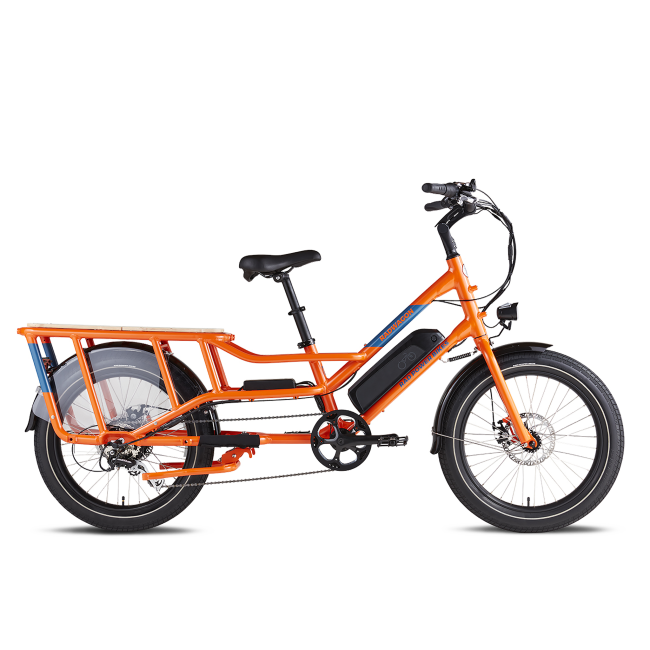
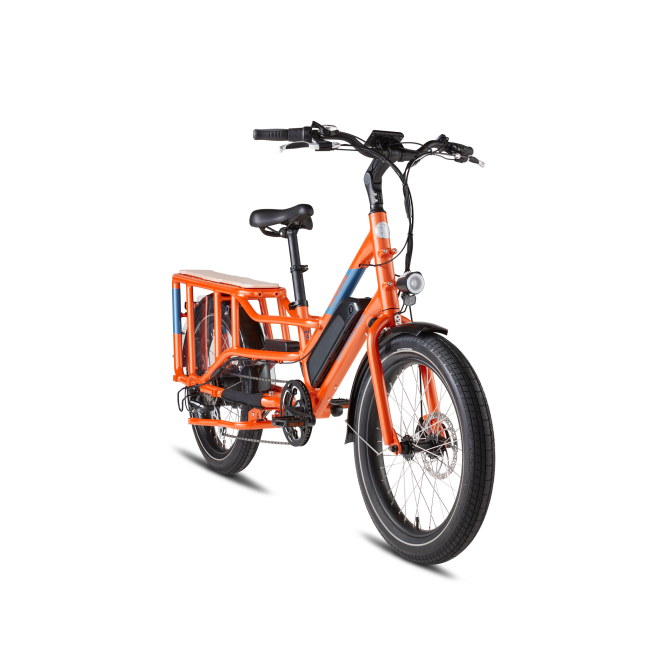
The Rad Power Bikes RadWagon 4 is the iconic, long-tail workhorse that originally put affordable, family-hauling cargo e-bikes on the map. As the immediate predecessor to the RadWagon 5, this model relies on a more traditional, analog-feeling e-bike design—opting for a cadence-sensing motor, mechanical brakes, and a fully rigid steel fork rather than the automated electronics, hydraulic components, and torque sensors of the newer generation.
Despite its older architecture, it remains a highly legendary machine, prized for its incredibly stiff mid-step frame, massive modular accessory ecosystem, and proven capacity to completely replace a secondary family car for local trips.
The Technical Snapshot
- Power & Performance: Powered by a robust 750W geared rear hub motor pushing out 80Nm of torque. It handles dead-stop starts with authority, delivering a smooth, predictable power curve that won't jerk or startle passengers when you take off.
- Battery & Range: Employs an external, frame-mounted 48V 14Ah (672Wh) battery built with premium Samsung cells (UL 2271 compliant). It yields a reliable real-world range of 25 to 45 miles, though pinning the throttle while fully loaded on steep inclines will naturally drag that closer to the 25-mile floor.
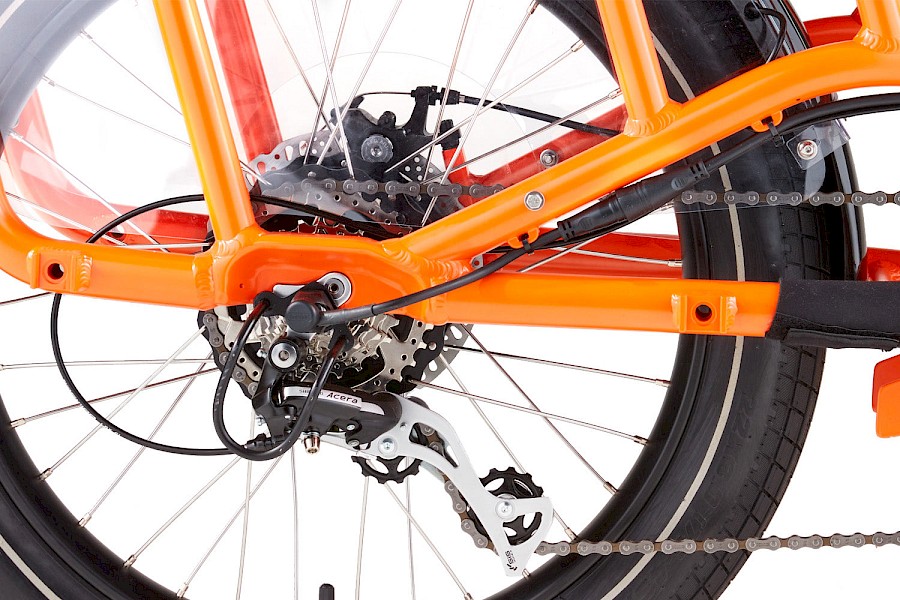
- Drivetrain & Speed: Operates strictly as a Class 2 e-bike, topping out at a regulated 20 mph via 5 levels of pedal assist or a right-hand half-twist throttle. Assistance is governed by a traditional 12-magnet cadence sensor and managed via a Shimano 7-speed drivetrain utilizing an upgraded Acera derailleur.
- The Proprietary Wheel Setup: Rides on a highly distinct, custom 22x3.0-inch tire and wheel layout engineered specifically by Rad Power to achieve a lower, safer center of gravity for the cargo deck.
Note: While excellent for balancing heavy loads, this proprietary size means replacement tires and tubes are almost exclusively sourced directly through Rad Power. If you are shopping for a used RadWagon 4, always double-check that the original tires were swapped out under Rad's historical tire/sidewall safety recall.
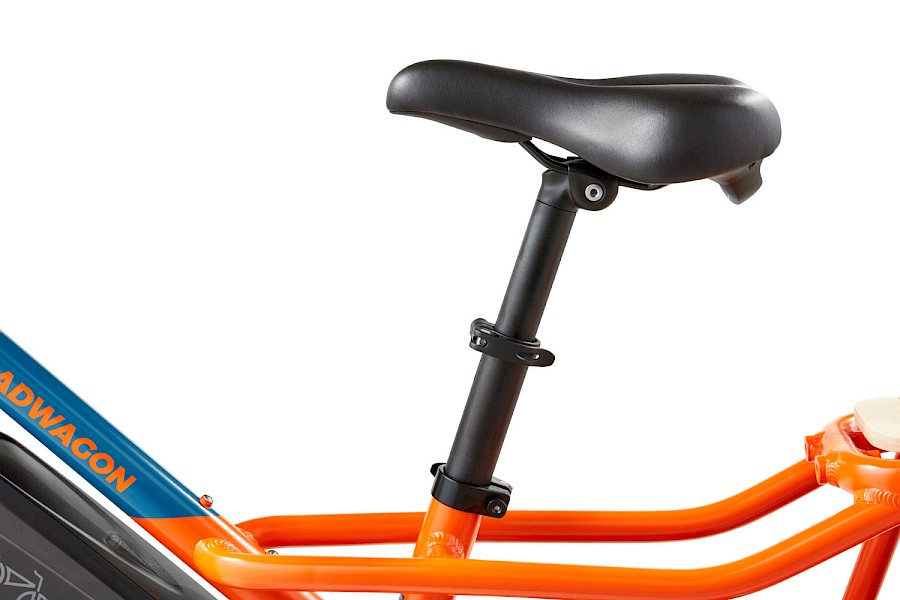
- Brakes & Comfort: Stopped by dependable Tektro Aries mechanical disc brakes clamped onto 180mm front and rear rotors. To maximize structural integrity under heavy loads, it ditches a front suspension fork for a rigid steel front fork, relying on the high-volume 3-inch tires, a plush saddle, and a tool-free adjustable stem to absorb road vibration.
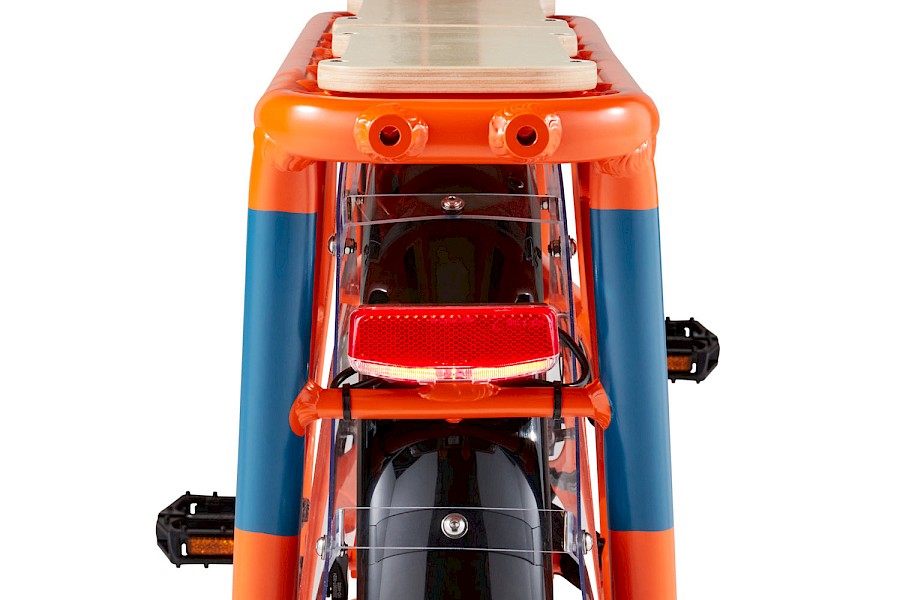
- Utility & Cargo Build: Tips the scales at a hefty 76.7 pounds but supports a stout 350-pound total payload capacity. Its elongated, integrated rear rack handles a 120-pound weight rating, making it perfectly sized to carry up to two child seats, running boards, or massive delivery baskets. It comes standard with full-coverage fenders, an ultra-stable dual-leg center kickstand, a backlit grayscale LCD display with a USB charging port, a 200-lumen headlight, and an active rear brake light.
Key Specifications
RadWagon 4
Performance
- Motor (Nominal)
- 750 W
- Motor (Peak)
- --
- Battery
- 672 Wh
- Battery (Ah)
- 14.0 Ah
- Range
- 45 mi
- Top Speed
- --
Practicality
- Price
- $1,999
- Weight
- 101 lbs
- Payload Capacity
- 350 lbs
- Foldable
- No
Real-World Range Estimator
Fine-tuned for the 672 Wh Battery
33.6 mi
Motor Type
Terrain Profile
The Science of eBike Range
Estimated range is total usable battery capacity divided by adjusted energy consumption: Range (mi) = Battery (Wh) ÷ Adjusted Consumption (Wh/mi). Manufacturer range claims are measured in ideal lab conditions, so this model starts from a real-world baseline and applies a multiplier for each factor you change above.
The variables
- Baseline: 20 Wh per mile, for a 180 lb rider on flat ground using standard assist with a hub motor. Every adjustment below is a multiplier against that number.
- PAS level: assist is banded rather than linear, because a controller delivers set power steps rather than a smooth ramp. Levels 1–2 draw 30% less energy than standard, level 4 draws 30% more, and level 5 draws 60% more — the jump at the top is steep because aerodynamic drag rises with the square of speed.
- Motor type: mid-drive motors run through the gearing, so they hold a more efficient operating range under load and consume roughly 14% less energy than a hub motor over the same route. Hub motors lose more to heat when they bog down on climbs.
- Rider weight: consumption rises 5% for every full 20 lbs over the 180 lb baseline, reflecting the extra rolling resistance and the energy lost accelerating more mass back up to speed.
- Terrain: a hilly profile adds 30% over flat ground. Regenerative braking recovers very little of what a climb costs, so elevation is close to a straight energy penalty.
This estimate is independent of the Battery & Range score in the rating breakdown, which scores the published specification rather than predicting a single ride. Treat the figure as a planning guide — tyre pressure, wind, temperature and stop-start riding all move the real number.
You May Also Like
Similar Models